
Liminal Tension
A new way to think about Imposter Syndrome so it stops holding you back
Quick Note: If you’d rather check out the audio/video version of this article, you can get it on YouTube, Spotify, Apple, or Other Places you get your podcasts.
No matter how much expertise, ambition, or discipline you have—Imposter Syndrome will always hold you back from fully stepping into what you know you’re capable of.
A lot of the work I do as a psychologist-turned-executive coach is helping founders, leaders, and creators remove the psychological bottlenecks costing them business growth, and Imposter Syndrome is one of the most common psychological bottlenecks I see.
Imposter Syndrome is often a symptom of Fear of Ridicule (one of the Four Horsemen of Fear), and it holds many of us back from putting ourselves and our ideas out into the world.
Because Imposter Syndrome, fundamentally, is the belief that you don’t belong in the room—whatever that room is (physical, virtual, or conceptual). So if you attempt to enter that room, you feel a cognitive resistance—a tension—that most people interpret as a sign to back off.
But what if it wasn’t a sign to back off?
I personally hate the term “Imposter Syndrome,” because it completely misdiagnoses what you’re going through. Instead, I like to use the term “Liminal Tension,” and here’s why…
The Problem with Imposter Syndrome
When you mentally label the tension you feel as “Imposter Syndrome,” it makes you think you’re a fraud who doesn’t belong. So anytime you start to enter a room and feel that tension, you pull back and tell yourself you need to wait until you feel “ready” or “prepared” before you try to enter the room again. “Then,” you tell yourself, “I’ll belong in the room.” Because everyone else in that room clearly deserves to be there because they have more expertise, more success, or are somehow superior to you in some way.
This is why labeling it as Imposter Syndrome holds you back. You have integrity, so you obviously don’t want people to think you’re a fraud, and you definitely don’t want to feel like a fraud internally.
So you wait until that magical day where you won’t feel like a fraud before you enter those bigger, better, scarier rooms.
But that day never comes, so you spend your entire life pulling back every time you’re on the precipice of a new room.
And again, that “new room” can be a physical one like speaking at a conference, a conceptual one like publishing a book that could sit on the same shelf as your favorite authors, or even an identity one like shifting from seeing yourself as a solopreneur of a tiny company to a CEO of a company you’re scaled into a “real” business.
Instead, you can learn to see that exact same tension as a good sign—a sign to lean in instead of pull back. If you re-label it as Liminal Tension.
But what does that mean?
A liminal space is the area between two things. It’s like a hallway between two rooms. While you’re in the hallway, you’re on your way from one room to the other, but you’re not in either. And right as you’re about to enter the room the hallway leads to, you have to cross the threshold to that new room.
It’s at this threshold that we feel maximum tension because it’s the final step before we actually enter the new room—the room we’ve maybe never been in before. And since we’ve never been in this room before, it’s easy to doubt ourselves into believing we don’t belong in the room.
I’ve experienced this in my own life.
Identity Ambiguity
I wrote online for about a year before I allowed myself to identify as a writer. Because I kept comparing myself to “real” writers who’d been doing it for years or bestselling authors. Of course I didn’t belong in the room with these writers—I was just starting out and finding my voice. Then one day one of my favorite writers reached out and said they loved my writing—now we’re friends. Then another writer who’d inspired me brought me on to collaborate on a writing project. Then writers started sending me their books, thanking me in their bestselling books (check out my episode with Ali Abdaal), asking to come on my podcast to talk about the craft of writing (check out my episode with Lawrence Yeo). Then I got invited to exclusive writer meetups with bestselling authors and deca-millionaires with writing businesses. But was I real writer? Am I real writer now? Do I belong in the room of real writers? When do I belong in the room of real writers?
The same tension holds anytime we try to cross the threshold to enter a new room.
When you try to take action that doesn’t align with your identity, you experience cognitive dissonance—which feels like mental static or anxiety because there’s a discrepancy between your self-belief and behavior. Which means if you want to take action to enter the room, you have to believe you belong in the room in the first place. Otherwise, you’ll self-sabotage (aka, change your behavior) to preserve the belief that you don’t belong in the room.
Put another way, identity is the foundation of aligned action. If you don’t believe you’re worthy of being in the room, you won’t take action to enter the room.
I see this all the time in my work with founders. Highly ambitious, accomplished, and disciplined people memorizing all the productivity “hacks” and trying to take action over and over but always somehow sabotaging their success at the last minute. Because their identity is holding them back (which is one reason so many people have a fear of success).
It’s not woo-woo to say you have to believe in yourself. It’s human psychology. Our behaviors are downstream of our beliefs. Everything we do, every action we take and every thought we have, is rooted in our beliefs (about ourselves and the world around us). We’re driven to reinforce our own schema of the world and ourselves, meaning we take actions that align with what we believe is true, possible, and deserved.
So if you believe you belong in the room, you’ll take the action of crossing the threshold. If you believe you don’t belong in the room, you’ll take the action to avoid crossing the threshold.
But if you learn to label that feeling as Liminal Tension, a sign you’re challenging yourself to grow, it’s much easier to cross that threshold. Because you’re not expecting perfection, you’re pursuing progress.
When I decided to become a public speaker and lead workshops and presentations for entrepreneurship conferences, there was obviously a point where I’d never done it before and had to cross the threshold into leading my first one. I could’ve easily told myself I didn’t belong in the room—or “Who am I to call myself a public speaker?”—but instead I reframed it as “Stepping into this opportunity, this room, will help me grow into the person I know I’m capable of.” I had to lean into the liminal tension that came up as I crossed the threshold from being not-a-speaker to being a speaker.
That liminal tension will always be there when you attempt to enter a new room because it represents the threshold of a new identity, a new skillset, a new life. What you’re feeling is the tension of growth, of evolution, of actualizing your potential.
Seeing it as liminal tension helps you reframe the initial belief of “This is a room I don’t belong in” into “This is a room where I’ll grow in.” And that allows you to take the aligned action of leaning in instead of pulling back to stay in your comfort zone.
But the reason we struggle so much to navigate this liminal tension comes down to human psychology.
Traversing Liminality: The Function of Rites of Passage
We don’t have rites of passage anymore, at least not at a societal level. Think about it—when did you know you were an adult? What makes you an adult? Is it when you turn 18? Get a job? Graduate? Have kids? Get a mortgage? Sneeze and almost bust a rib? Groan when he get up from the couch? So here you are, in your mid-30s and still look around the room for a “real adult,” only to realize that’s you.
A rite of passage offers a clear path to traverse the liminal space between two states. Without these, it’s hard to know when we’ve officially crossed the chasm and “arrived.”
Rites of passage are an antidote to Imposter Syndrome because they codify what it means to belong in the room. They offer clear structure and support to navigate the journey along with a concrete definition of when you’re “arrived.” If you survive this trial, you belong. If you don’t survive this trial, keep trying until you do—then you’ll belong. It might still feel surreal to be in the room, but you’ll know you belong because you passed the test. There are clear parameters.
But we don’t have these anymore, so we don’t have guidance on how to traverse the liminal. All we have is the tension we feel when we try to cross the threshold of the door leading to the room we deeply want to be in, which causes us to doubt we belong.
Now, you could try to come up with some elaborate ritual to act as a rite of passage to help you navigate this liminal tension.
Or you can learn to see this Liminal Tension itself as a rite of passage into a new identity, a new reality, a new life. Because everyone who’s ever inspired you constantly sought liminal tension and expanded their growth edges, which is why they continually leveled up and became a better and better version of themselves.
Final Thoughts
“The fastest way to change your life is to force yourself to level up by placing yourself in an environment where you feel like you don’t belong.” — Jay Yang
Take a second and reflect.
There’s a room right now that you’ve been at the threshold of entering for a while now, but keep pulling back because you label that discomfort as Imposter Syndrome. But “Imposter Syndrome” is a terrible misdiagnosis of what you’re experiencing. You’re not a fraud. You’re evolving. But the longer you delay entering that room, the longer you delay your own evolution. And you have too much potential to keep doing that.
What if instead, you chose to see that tension as a sign of growth and decided to lean into it?
What if you told yourself, “This tension is supposed to be here. I’m supposed to feel this because it means I’m growing and pushing myself.” How would that change how you act right now?
Pull out a notecard and write down this reminder:
The growth you seek is in the room you’re avoiding.
Liminal Tension is a much better term. So what tension will you lean into? What evolution will you finally give yourself permission to embrace? What new identity will you step into? Let me know—I’d love to learn more about you.
Read Next: The Four Horsemen of Fear
P.S.
You know your business is capable of more—that you are capable of more—yet you feel stuck despite all your ambitious, discipline, and achievements so far.
If you’re ready to get unstuck, check out The Growth Intensive, an exclusive two-day event where you’ll meet other incredible founders and learn how to remove the inner and outer blockers holding your business back from what you know it’s capable of achieving.
I’ve partnered with Darrell Vesterfelt, one of my favorite entrepreneurs, to host the exact type of event we wish existed (which is why we created it).
Here’s a picture from the last Growth Intensive we hosted in Minneapolis:

Two days of intense work diving deep into founder psychology and business strategies that most people never uncover, which is why you stay stuck at a revenue and impact level that’s respectable, but nowhere near your potential.
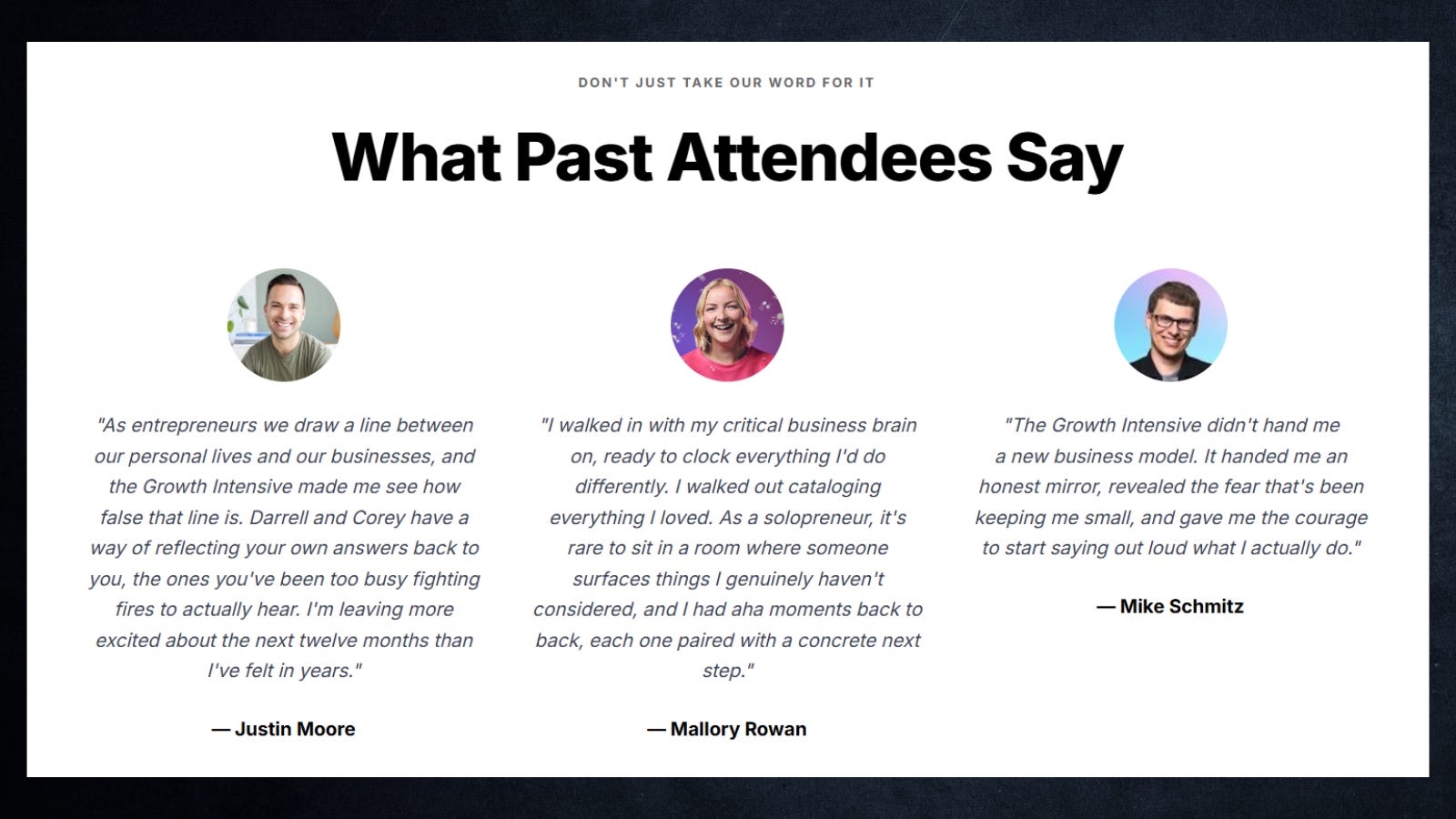
Here’s what a few incredible founders had to say about their experience:
Every Growth Intensive is capped at only 25 seats, so click below to learn more and grab your spot before they fill up: